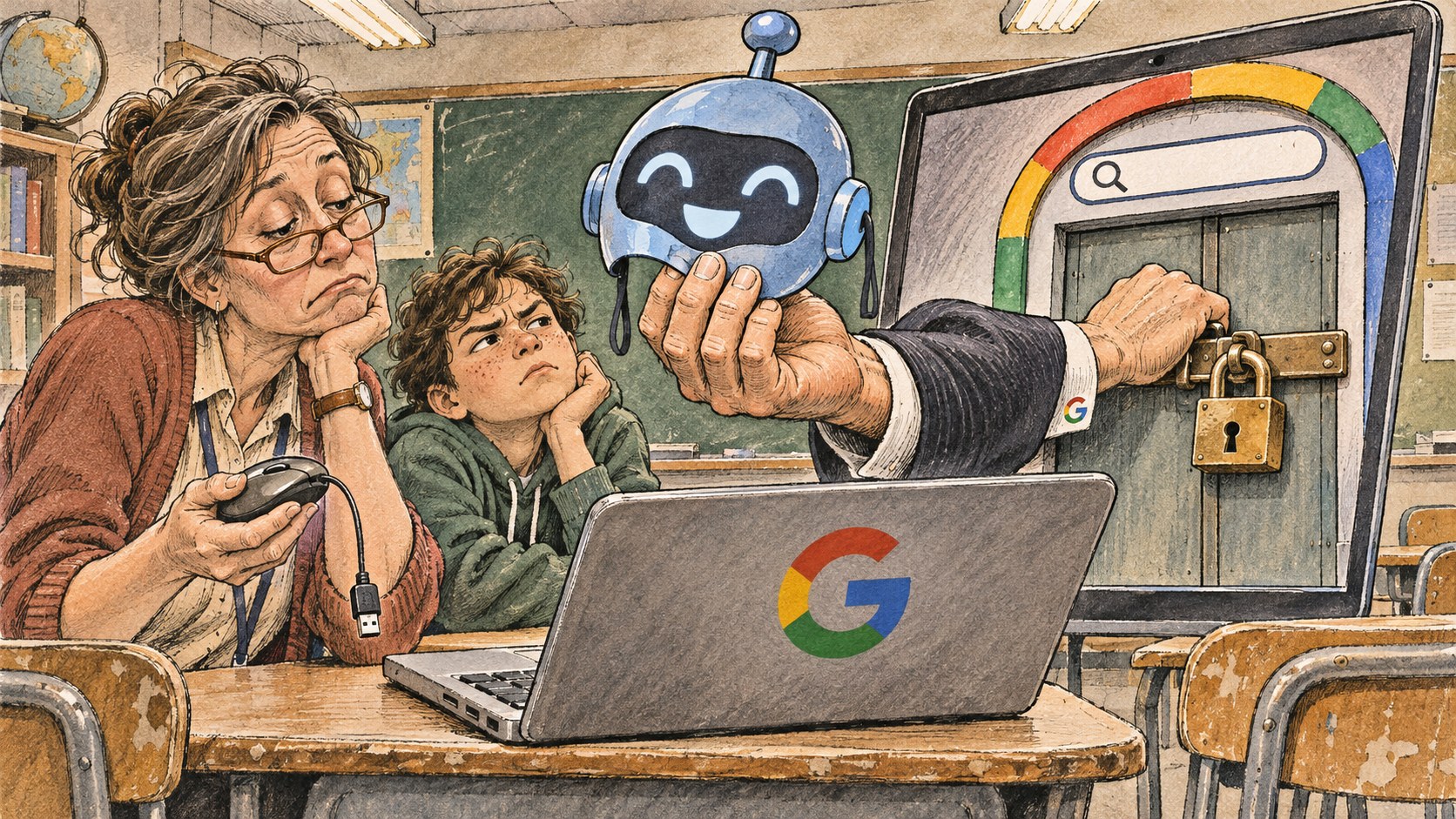
MOUNTAIN VIEW, CA—Reaffirming its commitment to classroom independence, Google has offered schools a straightforward choice: embrace artificial intelligence or become the principal who has to explain why a seventh grader can no longer look up a frog.
“We listened to teachers,” a company spokesperson said. “They wanted the ability to say no. We’ve built that ability. It works beautifully. Everything stops.”
The announcement marks a significant advance in educational choice, a concept previously limited by the assumption that declining one product would allow you to keep using another.
Google described the arrangement as a natural consequence of integrating AI into Search. Separating the two, the spokesperson explained, would be like ordering a sandwich and asking the restaurant to remove its five-year strategic growth plan.
At a hastily convened school board meeting in suburban Ohio, technology director Martin Bell demonstrated the new controls by projecting two options onto the cafeteria wall.
“This one turns it on,” Bell said.
“And that one?” asked a parent.
“That one schedules this meeting again.”
Board members spent forty minutes debating whether AI would erode students’ ability to think independently before asking Bell which button other districts were clicking.
For English teacher Denise Marsh, the dispute has complicated an already delicate classroom policy.
“I tell them they need to develop their own ideas,” she said. “Then I send them home with a laptop whose manufacturer has apparently negotiated custody of that process.”
Marsh acknowledged that students needed help navigating new technology. Last week, she caught a student submitting an essay that described Of Mice and Men as a celebration of workplace resilience.
“He said the AI wrote it,” she said. “I said he was responsible for checking it. He asked why the school gave him a machine he couldn’t trust. I told him that was an excellent question and to put his phone away.”
District administrators have proposed a compromise under which students may use AI to assist their thinking, provided teachers can determine where the assistance ends and the thinking begins. Teachers will receive a forty-minute training session and a laminated card.
Meanwhile, parents have demanded an immediate return to an education untouched by corporate influence, pausing the discussion briefly to use the Coca-Cola machine outside the gym.
“We can’t let a company decide how our children learn,” said one father, whose employer had just informed him that completing an AI certification was now part of his annual performance review. “They should at least wait until the children have mortgages.”
Google stressed that schools remained free to explore alternatives, including other search engines, printed reference materials, and whatever the librarian had been trying to tell them before her position became a charging station.
Bell has begun investigating those options. Unfortunately, the district’s procurement form requires him to identify an approved vendor before he can request approval for a new vendor.
“It’s designed to keep us from becoming dependent on one company,” he said.
Back in Marsh’s classroom, the controversy briefly produced the kind of independent inquiry educators had been hoping for.
A student raised his hand.
“If we can say no, but they take away something we need when we do, is that really a choice?”
Marsh put down her marker.
For the first time all morning, everyone was paying attention.
“Good,” she said. “Keep going.”
He looked at his screen.
“It says I need administrator permission.”